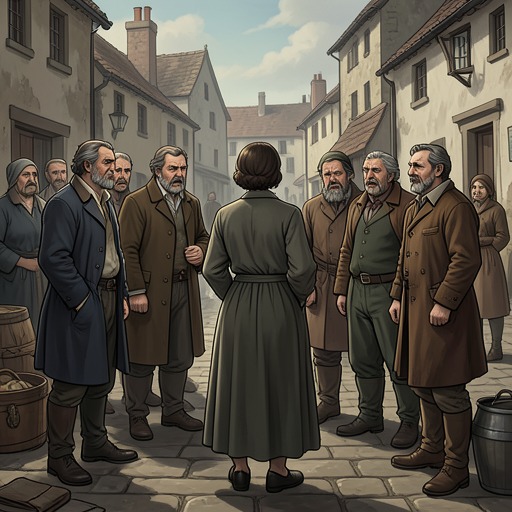
Jane Wilson
The Tenant of Wildfell HallJane Wilson is a farmer’s daughter whose education has given her elegance and social polish, but whose ambition is directed toward a rich gentleman and the status his name and fortune promise. First presented amid village speculation about her attention to Mr. Lawrence, she later becomes the object of Gilbert Markham’s intervention: he tells Mr. Lawrence that Jane’s apparent charm conceals a cold, calculating hostility toward a woman she regards as a rival. The courtship ends, and Jane is left embittered. Her brief arc links the village’s appetite for gossip to the novel’s scrutiny of the distance between a woman’s public refinement and the character attributed to her by others.
Identity and Ambition
Jane is the daughter of Mrs. Wilson, a farmer’s widow, and sister to Robert Wilson and Richard Wilson. Unlike her brothers, she has received a regular boarding-school education at her own request. The schooling has set her apart from the family: she has acquired elegant manners and lost her provincial accent, making social advancement seem within reach.
Her beauty and polish, however, do not translate in Gilbert’s account into romantic feeling. He describes her as talented and ambitious, but judges her to be without poetry or feeling. The sharpness of that assessment matters: Jane’s aspirations are not framed as a desire for affection or compatibility. She rejects suitors from her own rank, wanting a gentleman, and believes that only a rich one can satisfy her ambition. The narrative thus makes class aspiration central to her courtship, while leaving her inner life largely filtered through other people’s judgments.
Courtship and Village Speculation
Mr. Lawrence, a young squire whose family once occupied Wildfell Hall before moving to a more modern house in a neighboring parish, has lately paid Jane pointed attentions. Village talk turns those attentions into a story about her intentions: people whisper that she has designs on his heart, name, and fortune. The rumor presents Jane not simply as a possible bride but as someone calculating the full social and material value of marriage.
At a gathering attended by Helen Graham, Eliza Millward asks whether Jane and Mr. Lawrence are acting like strangers. Gilbert observes that Mr. Lawrence sits apart from the young widow, between Mrs. Markham and Rose Markham. When Eliza’s insinuations begin to connect Helen with Mr. Lawrence, Gilbert challenges her directly and objects to repeating ill-natured reports. This exchange places Jane’s courtship within a wider culture of speculation: the same company that interprets her ambitions also uses rumor to assign meanings to other women’s relationships.
Gilbert’s Intervention
Some time later, Gilbert meets Mr. Lawrence returning from a visit to the Wilsons and decides to warn him about Jane. He insists that his intervention is not revenge for his own recent annoyance and not malevolent hostility toward Jane; he says he cannot endure the thought of her becoming Mr. Lawrence’s sister-in-law. Gilbert tells Lawrence that Jane hates Helen, although he acknowledges that her hostility may arise from ignorance of their relationship. He then distinguishes that possible misunderstanding from what he regards as deliberate malice toward a supposed rival.
Gilbert names the qualities he believes Mr. Lawrence has misread: Lawrence sees Jane as charming, elegant, sensible, and refined, whereas Gilbert considers her selfish, cold-hearted, ambitious, artful, and shallow-minded. The episode gives Gilbert’s account consequential force, but it remains his judgment, not an independent view of Jane’s thoughts. The reader sees her chiefly through competing acts of interpretation: the village whispers about her designs, while Gilbert claims to expose the character beneath her refinement.
Disappointment and Significance
Mr. Lawrence’s response is not recorded as a direct confession of belief, but Gilbert later concludes that Lawrence came to regard his former attraction with amazement and to congratulate himself on escaping the match. Lawrence never acknowledges Gilbert’s role in the change. Jane, for her part, is described as disappointed and embittered by her admirer’s sudden coldness and eventual desertion.
Gilbert asks himself whether he was wrong to blight Jane’s hopes and decides that he was not; he says his conscience has never accused him of an evil design. That self-assessment does not erase the asymmetry of the episode: Jane’s prospects are altered by a private warning from one man to another, and her own account is absent. Her character therefore serves both as a portrait of status-seeking courtship and as a reminder that the novel’s social judgments about women are mediated by gossip, reputation, and male narrators who claim authority to distinguish genuine feeling from calculation.